Article - May 16, 2022
Contract development and manufacturing organizations (CDMOs) provide a range of services to pharmaceutical and biotech companies within the development and manufacturing cycle. These companies are increasingly turning to CDMOs to access outsourced manufacturing infrastructure, more efficient drug development, and higher returns on approved therapies. This trend is accelerating growth and creating M&A opportunities.
Here, senior professionals from the Harris Williams Healthcare & Life Sciences Group share their thoughts on why the CDMO sector is generating investor interest, which trends are most relevant to M&A, and where the most promising opportunities lie in the sector.
Why is the CDMO sector appealing to buyers and investors?
CDMO growth is outpacing the wider pharmaceuticals market as large-cap pharmaceutical and biotech companies increasingly outsource to control capital expenditures and reduce fixed costs. These accelerating outsourcing trends span the value chain, from development services to commercial scale manufacturing.
“CDMOs have seen tremendous growth due to the amount of innovation in pharmaceuticals around drug delivery mechanisms, including cell and gene therapy, biologics, and all of the different components that are going into mRNA-based vaccines,” says Managing Director Paul Hepper. “Those therapies are built off large molecule manufacturing, or biology experiments, compared to small molecule manufacturing, which are chemistry experiments. It’s an area that has seen an explosion in growth. The outsourcing trends are very positive, and the market is expanding.”
Private equity interest in CDMOs has also grown as sponsors continue efforts to diversify beyond traditional provider services businesses. “Increased PE interest has led to a step up in valuation multiples to new highs across the sector,” notes Vice President Lucas Scholl. “That interest is expected to continue. Outside of large-scale commercial small molecule manufacturing, the market is extremely fragmented. There are very few players of scale, putting us in the early stages of platform-building for private equity.”
“Investors are coming from many directions,” adds Hepper. “The earliest and deepest investor groups have been those that understand pharmaceutical services. There’s also been crossover from companies that understand contract manufacturing, either from an adjacent sector, such as medical devices, or even from outside of healthcare, such as industrial manufacturing. Interest from general healthcare investors is also on the rise as those companies develop a deeper understanding of this complicated sector and look to diversify their investment strategies from the services sectors they have historically focused on.”
What are some of the key trends driving CDMO growth?
Pharmaceutical and biotech companies of all sizes are outsourcing to decrease time-to-market, reduce costs, simplify complexity, and reallocate internal resources. Small- to mid-cap organizations, for example, typically lack the resources or capabilities required to commercialize new products on their own. This is leading them to increasingly outsource key areas, so they can capitalize on growth opportunities. Large pharma is also outsourcing at a higher rate, specifically in the R&D and manufacturing areas. For both types of organizations, says Scholl, CDMO outsourcing is at an earlier stage than CRO outsourcing, but will likely follow the same growth trajectory.
In addition, geographic expansion is driving outsourcing among both large and small companies—a trend Harris Williams executives heard at DCAT Week, an event sponsored by the Drug, Chemical and Associated Technologies Association.
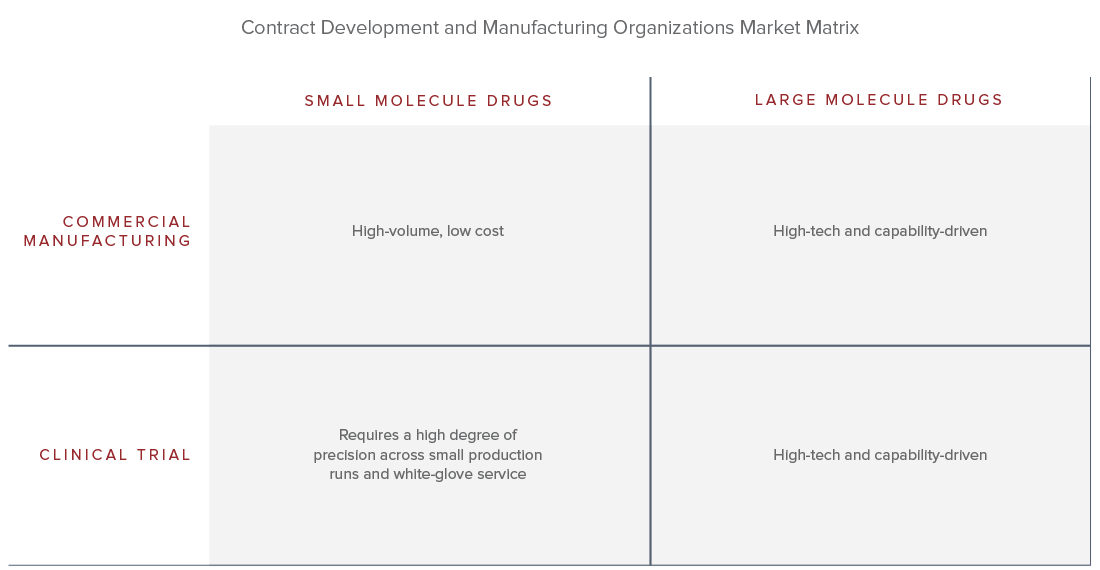
Hepper explains the market as a two-by-two matrix with the horizontal axis as small versus large molecule drugs, and the vertical axis as clinical trial or commercial manufacturing (Figure 1). According to Hepper, each one of those quadrants has a unique dynamic:
- Small molecule/clinical trial is largely less technically complex than large molecule, but requires a high degree of precision across small production runs and white-glove service
- Small molecule/commercial manufacturing is high-volume, low-cost
- Large molecule/clinical trial and large molecule/commercial manufacturing are both high-tech and capability-driven
Figure 1
“A company needs the right scientific expertise and manufacturing capabilities to be successful in the space. Pharmaceutical companies have historically owned their own small molecule commercial manufacturing. However, it is less likely that companies of any size will build large molecule manufacturing capacity. This is due to the high fixed cost associated with manufacturing and development, as well as the small volumes and specialization required,” says Hepper.
The supply chain vulnerability highlighted by COVID-19 is also creating tailwinds for CDMOs. Drug shortages early in the pandemic were a result of disproportionate reliance on manufacturing in countries such as India and China. Many pharmaceutical companies that were heavily reliant on global manufacturing are now looking to reduce their supply chain vulnerability by having multiple sourcing options. U.S. Government funding to support domestic manufacturing capacity expansion has also led to increased interest in U.S.-based manufacturing businesses, including CDMOs.
Finally, ongoing shifts in medicine favor CDMOs. Pharmaceutical industry growth is being bolstered by several general trends, including the aging population and a corresponding increase in incidence rates for chronic and lifestyle diseases, as well as better insurance coverage among those in developing countries. New drug development and improved diagnoses are also increasing demand for medication. In addition, many legacy products are losing patent exclusivity rights, and demand is being replaced by biologics, which target smaller patient populations and require small batch manufacturing. In fact, the share of biologics in the total sales of the top 100 drugs is expected to reach 55% by 2026.[i]
“CDMOs are in the early stages of building capacity to meet the growing demand for biologics,” says Managing Director Cheairs Porter. “CDMOs are looking to expand manufacturing capacity in aseptic manufacturing, sterile fill-finish, and lyophilization. Aseptic manufacturing requires specialized equipment and highly trained personnel, as well as additional regulatory and quality considerations, all of which create opportunity for CDMOs.”
Where are the most promising opportunities for buyers and investors?
Recent market feedback suggests that the attributes investors value differ based on whether the platform focuses on small or large molecule therapeutics.
Large molecule drugs (biologics, advanced therapies, viral vector, DNA/Plasmids, and mRNA) are highly sought-after sectors that industry stakeholders believe are in the early stages of growth. Strategic investors value depth and scale when assessing product capabilities, and ascribe limited value to sub-scale, adjacent complementary services.
“Strategics are very focused in looking for add-ons. They are using M&A to fill a capability void,” notes Hepper. “The delineation here is really around the type of manufacturing the platform offers, and how it fits into a strategic’s capability needs. A well-run facility that can be an entry point into a particular type of manufacturing is very attractive to a strategic. Winning large molecule platforms focus on core capabilities, and on developing speed, efficiency, and capacity to deliver product in a market where demand already far outstrips supply.”
There are also opportunities in the small molecule space, particularly for middle-market platforms that focus on clinical production and high-touch service. “It’s an attractive market where larger CDMOs have not focused,” says Hepper. “Large-scale manufacturers are not optimized to run the small batches customers need for clinical trials. Small or medium-sized CDMOs can really win on the ability to manufacture small batches quickly with very high quality on the terms the customer needs.”
Scholl adds that building a strong business development function is key. “Often, these small and medium-sized businesses are not going to be doing the commercial manufacturing once the small molecule drugs they are producing move out of clinical trial. They must consistently be filling their pipeline with new opportunities to drive growth and win share.”
Conclusion
In sum, the CDMO sector is an attractive area for private equity investment. It’s a large and highly fragmented market in early stages of development that will likely draw healthy multiples for years to come.
The most promising assets in large molecule manufacturing focus on core capabilities with depth and scale, as well as speed, efficiency, and capacity to deliver product on schedule. On the other hand, investors interested in the small molecule space should be on the lookout for platforms that are optimized to manufacture high-quality small batches with speed and precision.
To learn more, please contact our senior bankers.
Rapidly changing technologies and a constantly shifting regulatory environment are facts of life in the healthcare and life sciences marketplace. Our Healthcare & Life Sciences Group is dedicated to understanding this complex industry and providing superior merger and acquisition advisory services to companies that operate within it.
Select Harris Williams Healthcare & Life Sciences Transactions: