Article - December 15, 2021
Under pressure to become more efficient in drug development and maximize returns on approved therapies, pharmaceutical companies are increasingly looking to outsourcers to boost speed and efficiency across their value chains. As a result, the outsourced pharmaceutical services sector provides a wide range of opportunities for strategic acquirers and private equity investors.
In this article, professionals from the Harris Williams Healthcare & Life Sciences Group and Technology Group discuss real-world evidence, an especially promising space within outsourced pharmaceutical services. The team draws upon recent experience with Kantar Health to illuminate the specific traits investors value most. (See our Return on Innovation Series)
Beyond the Lab
With many blockbuster drugs entering the generic phases of their lives, big pharma is finding growth in the nooks and crannies: increasingly complex, lower-incidence conditions such as specific forms of cancer. That makes it more difficult to discover, develop, and commercialize treatments using traditional methods involving large swaths of the general population.
Enter real-world evidence (RWE), a rapidly growing sector in the pharmaceutical services market. Aligned with some of the most powerful dynamics in drug discovery and development, RWE provides savvy investors with a rare opportunity to help bring tomorrow's most important treatments to market.
RWE is the gathering and interpreting of data that already exists in the real world, rather than through a highly controlled clinical trial. RWE data supplements findings from clinical trials, and may include:
Clinical records examined over time
Insurance claims data submitted by physicians, which can identify symptoms, diagnoses, and procedures
Patient-reported outcomes data
Labs, scans, and biological samples
Pathology and genetic sequencing from biopsies
Socioeconomic data or social determinants of health data such as diet, activity levels, or patient access to health and economic resources
This vast universe of data originates from electronic health records, patient surveys, panels, and patient registries, and it's compiled by data aggregators. Thousands of pieces of clinical data, claims data, and biological samples are linked together on a patient-identified or anonymized basis to identify patterns that become real-world evidence.
Once collected and aggregated, RWE can help drug developers transcend the limitations of clinical trials. By tapping into the enormous sea of available health data, drug developers can conduct the analyses they need to ensure the safety, efficacy, and real-world value of treatments intended for smaller populations.
For instance, as new drugs undergo commercialization, RWE allows pharmaceutical companies to provide greater evidence of efficacy and value. Payors want drug manufacturers to demonstrate real-world economic and societal value to support drug reimbursement and pricing. Physicians demand real-world validation of improved clinical efficacy before they prescribe new therapies. Patients want measurement of the outcomes most important to them and their quality of life. RWE can help pharma companies meet all these demands much faster and more efficiently than conducting a phase-four clinical trial because it involves aggregating and mining data that already exists. In some cases, a pharma company may use RWE to supplement a much smaller phase-four trial. In others, it may rely on RWE exclusively to build the needed evidence. Johnson & Johnson, for example, recently combined a trial with a large body of RWE to demonstrate the long-lasting protection of its COVID-19 vaccine.[1]
RWE is also uniquely suited to address many challenges related to R&D. It can help drug companies improve efficiency, manage regulatory complexity, increase the success rate of drug discovery, contain development costs, and reduce time to market. RWE may help identify candidates for a clinical trial, supplement clinical trial data, or be used in lieu of clinical trial data for new indications.
It can be particularly difficult and time-consuming to find patients with rare diseases to participate in a clinical trial. Data sources such as patient registries can be very useful in identifying the right patient mix, and in efficiently supplementing a trial with real-world evidence.
Gathering evidence that known drugs are effective for new uses is also a highly applicable, and common, use of RWE. “If the company has a drug on the market for one purpose, but believes it may have applicability for a different indication, RWE can help prove it is effective for this different indication and that it is safe,” explains Linsalata. “Using big data and analytics, this can be done more quickly and with lower cost than clinical trials.”
In addition, regulators are expanding their reliance on real-world data beyond the traditional drug surveillance and safety applications. Rather than enduring a lengthy, highly controlled clinical trial, pharmaceutical companies can gather statistically relevant evidence of the drug`s performance in the real world. RWE continues to gain traction as governing bodies embrace the concept and develop frameworks for integrating RWE into the regulatory process.
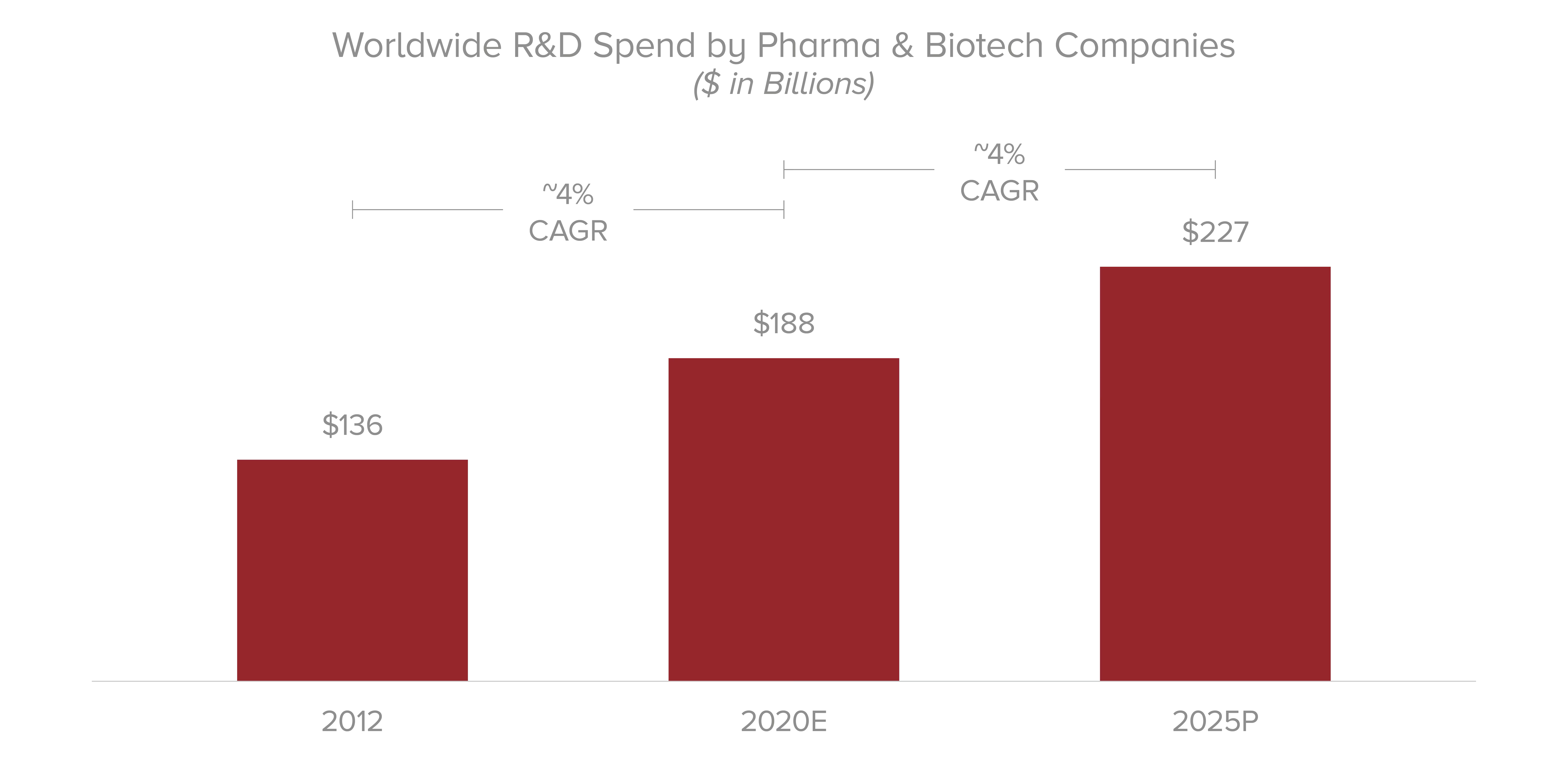
In combination, these tailwinds will drive continued RWE spending with specialized outsourced service providers into the foreseeable future. As shown in Figure 1, worldwide R&D spending by pharma and biotech companies is expected to grow by approximately 4% through 2025, reaching $227 billion.[2]
Figure 1: Steady Growth in Global R&D Spending
Source: Evaluate Pharma World Preview 2020, Outlook to 2026 (July 2020)
There are three basic types of solutions providers competing for a share of this spending. The first: data providers with proprietary or uniquely deep or rich data sets to offer analytics companies, such as patient registries. These pure data providers tend to focus on a specific disease area or data type, such as claims data, clinical records, or prescription data. A second form of company is an analytics tool provider, and the third, most numerous, type is the people-based, project-based consulting firm. Hendler and Linsalata believe that companies will increasingly bring all of these capabilities together to provide pharmaceutical companies with RWE-as-a-service solutions on a recurring revenue model.
“Companies would have a bench of key opinion leaders in a specific field who understand the right questions to ask. They'd have their own data linking capabilities,” Hendler says. “They would source the data from wherever they need to source it, and have biostatisticians on the back end to help interpret the results. It's very much a technology-enabled service.”
Case in Point: Kantar Health
Kantar Health—now known as Cerner Enviza—is one example of a company experiencing significant growth as an RWE provider, as it aggregates, analyzes, organizes, and interprets real-world data. Harris Williams advised Kantar Health, a division of Kantar and portfolio company of Bain Capital Private Equity, on its sale to Cerner Corporation.
Kantar migrated into RWE from its life-sciences consulting business, where it built strong analytical skills for client-specific projects. It brings together real-world data capabilities, proprietary and syndicated data sources, and biostatisticians to interpret analyses.
Linsalata notes that the company's scale is unusual in this space. “It has a global infrastructure with more than 650 employees strategically located across 17 countries. It provides comprehensive, end-to-end custom research and syndicated data offerings to help inform and support customers' decisions throughout a drug's life cycle. The company also has an exceptional reputation built from long-term relationships with pharmaceutical companies, and a long track record of successfully completed projects.”
Cerner, a leading player in the electronic medical records (EMR) sector, was not an obvious potential buyer. The company identified an opportunity to partner with healthcare providers to monetize EMR data for RWE and the Kantar Health acquisition was a critical link in this strategy as it provided Cerner with an entrée into the pharmaceutical industry. The transaction exemplifies the growth opportunity companies see in RWE.
The Ground Floor
Gone are the days when new blockbuster drugs aimed at millions of patients generated billions in revenue for big pharma. The future of pharma is more targeted, with bespoke treatments for specific populations dominating R&D pipelines. That limits the effectiveness of clinical trials and makes them more time-consuming and costly.
However, the revenue potential is still there, and RWE will be vital to unlocking it. In this new paradigm, RWE enables drug developers, providers, payors, and patients to more deeply understand efficacy and safety—with greater speed and completeness than clinical trials alone. And because few large pharma companies possess deep in-house RWE capabilities, now is a great time to build tomorrow's leading platforms.
Where to start? Many scenarios can be attractive. By aggregating small platforms, investors can reduce key-person and concentration risk, align data sources, and scale novel technology toward real commercial opportunities that generate value.
See our Return on Innovation Series for more outsourced pharma services insights. To discuss aggregation opportunities in RWE, please contact our senior bankers.
Johnson & Johnson Announces Real-World Evidence and Phase 3 Data Confirming Strong and Long-lasting Protection of Single Shot COVID-19 Vaccine in the U.S., Johnson & Johnson, September 21, 2021
Evaluate Pharma World Preview 2020, Outlook to 2026 (July 2020)