




Article - November 4, 2020
In any economic climate, an acquisition can improve performance and increase scale. In times of economic uncertainty, an acquisition also can reduce risk by providing customer, geography, or product range diversification. But, for first-time acquirers, an acquisition can seem daunting. With no experience to lean on, most private companies may not have an appreciation of all that`s involved and, more important, what`s absolutely necessary for a deal to be successful.
In this three-part series, Harris Williams shares some of its key insights on managing the complexities of M&A. Part one shared five fundamentals for successful acquisitions. This second installment steps through the acquisition process, and part three will provide concrete guidance on maximizing value after the acquisition is complete.
Overview
As noted in part one of this series, the most fundamental key to M&A success is having a clear understanding of how an acquisition program contributes to the organization's strategic goals. Only when the company can translate business objectives into a well-founded, actionable M&A strategy should the process begin.
Serial acquirers will have a pipeline of potential deals at various stages. However, whether a company is pursuing an acquisition for the first time, making opportunistic deals as they arise, or managing a full acquisition pipeline, the four phases of the acquisition process are the same.
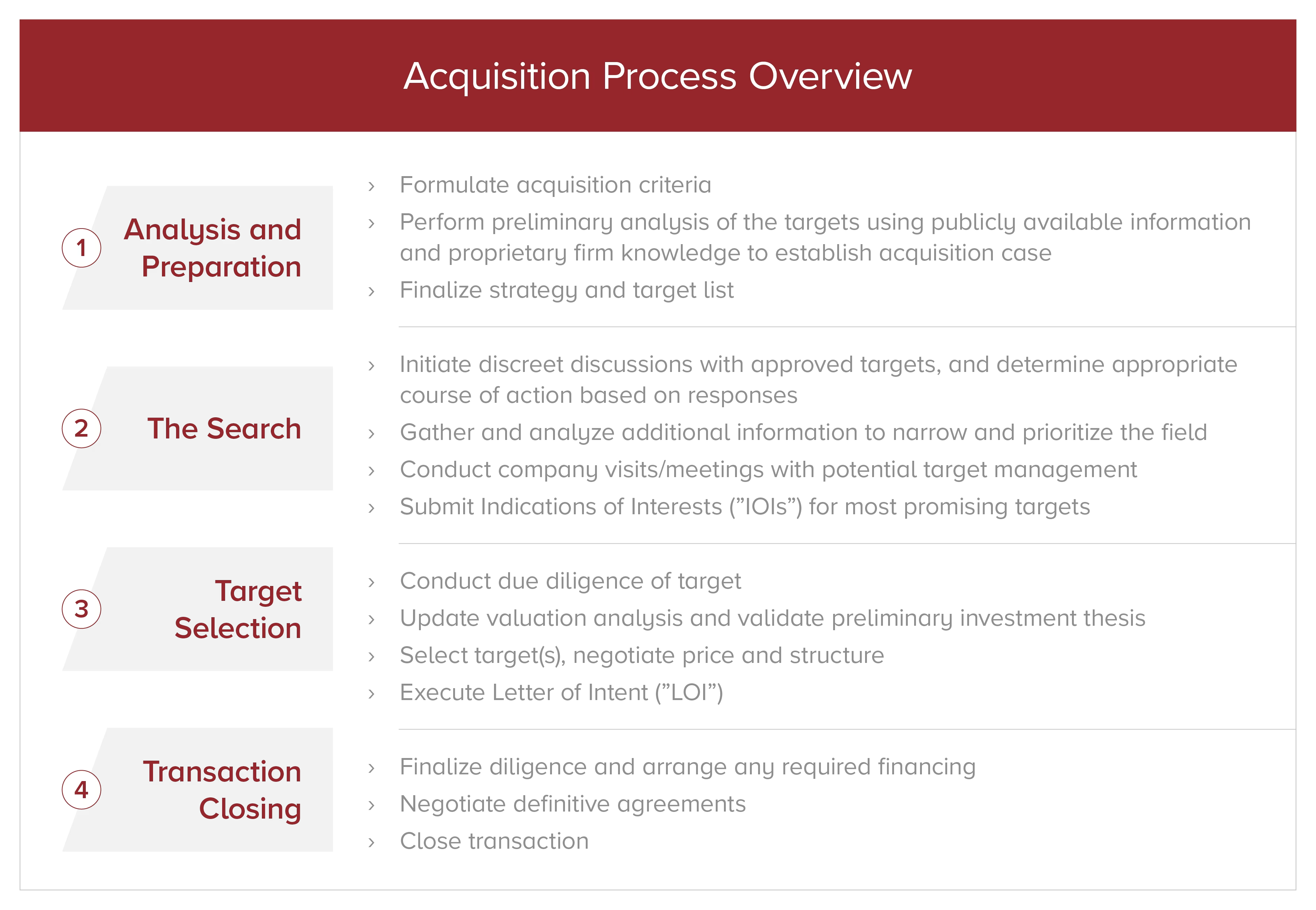
Analysis and Preparation
Acquisition begins with the formulation of criteria. “When going through comprehensive screening, buyers should be able to assess opportunities based on a set of criteria that they use to support their investment thesis,” says Larissa Rozycki, a managing director. “These typically include desired size profile, market segments, geographical regions, products, service offerings, capabilities, technologies, and customers served.”
Once acquisition criteria are established, buyers can begin to identify and screen the universe of companies that could potentially bring value to their organization. Rozycki notes that buyers often overlook resources that are already available to them when creating a potential target list.
“For example,” she explains, “scanning trade association membership lists and attending trade shows to hear how companies pitch their business are good ways to learn more about targets that may not have previously been identified. Also, employees in customer-facing roles within your organization, such as sales representatives, often know competitors or unique companies serving your same clients. Customers also can provide insight on suppliers that perform well and those that don`t. These efforts, along with publicly available information, will help you begin to build a universe to explore further.”
Preliminary Analysis of Potential Acquisition Candidates
Company profile
Financial performance
Competitive positioning
Product portfolio
Customer base
Distribution channels
Geographic presence
Potential operating synergies
It's beneficial to prioritize the target list by actionability, adds Rozycki. “Prioritization directs resource allocation. Ownership dynamics, such as whether a company has a clear succession plan or not, can be an indicator of how actionable a particular target is, for example.”
“Building these relationships is a marathon and an exercise in patience,” highlights Rozycki. “Some acquisitions, especially the most desired targets, may not be real opportunities for the next 10 years, but companies need to build rapport and get to know management so they are the first phone call when the time is right. Lay the groundwork early, whether that is establishing some kind of a business relationship, or partnership, or connecting on a personal level. Perfect targets are worth the time and effort.”
The Search
The intention of phase two, the search, is to get to know targets better through preliminary diligence and company visits, and to ultimately submit Indication of Interest (IOI) letters to promising targets.
A company may have multiple targets in the search phase concurrently, or just a few if they are first-time or opportunistic acquirers.
Before reaching out to target companies, gather and analyze additional information to narrow and prioritize the field. Start by culling internal team knowledge of the target company in terms of capabilities, products, services, management team, and customer relationships as well as customers' thoughts about the target. Then fill any gaps with external information, such as news searches, trade publications, trade shows, speeches, and the target`s website.
It`s extremely important to think through in advance how to initiate discreet discussions with approved targets. Quality companies have many entities reaching out to them, from private equity firms to investment banks and even competitors, and it`s critical to stand out from the pack versus being part of the noise.
“In every individual conversation, prospective targets want to feel as if they are a high priority for your company,” emphasizes Rozycki. “Acquirers should be mindful of how each conversation is progressing and what is needed to keep the ball rolling so that they can be completely responsive and timely—especially if they are having multiple conversations in parallel and have limited internal resources.”
published
hw-privatecompaniesgraphs-1015_2.png
Through preliminary diligence, the acquirer should be able to determine whether the target is a company it wants and whether the seller would entertain selling. “Information flow happens in stages,” says William Watkins, a managing director. “A buyer won`t get all the data needed up front to run full diligence unless the target is prepared for a sale, such as when an investment banker is retained. There will be a number of different stages of discussions, each getting a little deeper. Targets may be sensitive to sharing information initially, preferring to trickle out more as the relationship progresses and comfort increases.”
Company visits and meetings with target management are natural progressions in relationship-building, says Jules. “If the target is serious about having an acquisition conversation, management should expect the acquirer to want to meet them in person to take a tour of their facilities and see the operations. It`s critical to actually meet folks, see how they go about their business, walk the floor, and see how the facility is kept up. But, in the current environment, companies are finding creative ways to conduct virtual diligence and build relationships with sellers that take them a long way toward their goals prior to in-person meetings.”
Examples of Possible Red Flags
Excessive customer concentration
Customer acquisition and retention issues
Poor margins (although difficult to attain at early stage)
Systems or human capital gaps
Poorly run facilities or operations
Submitting a non-binding Indication of Interest is the next step in advancing the relationship with promising targets. It shows a willingness and ability to consummate and finance the transaction.
Different methodologies are commonly used for valuation, including market- and cashflow-based approaches. Rozycki recommends that companies take a look at multiple methodologies and develop a valuation range based on those that apply to the situation. “In a competitive situation, for example, it's beneficial to know how a financial sponsor would value the company. This is certainly a time when people tend to rely on having bankers or buy-side advisors involved to help them value the acquisition and walk through due diligence. Recognize that being reasonably aggressive about the valuation submitted will ensure the conversation doesn't stall at this early stage over a perceived low value.”
Synergies are an important valuation contributor at this stage, says Watkins: “You should be quantifying the value of potential synergies ahead of arriving at your valuation, then use confirmatory due diligence to fine-tune those assumptions as more information becomes available. Estimate hourly wages, salaries, and benefits. Focus on operational redundancies, potential facility consolidation, supply chain savings, and tangible cost savings. There are also potential revenue synergies, whether it be new distribution channels, new geographies, new products, service capabilities—but be more conservative on these estimates, as you have less control over them.”
Basic IOI Checklist
Expression of enthusiasm for the transaction that conveys a compelling perspective on why the company is a good fit
Details on the valuation range
High-level deal structure and terms
How you plan to finance the transaction
Timelines: major milestones and how long it will take to get to each
Conditions for moving from milestone to milestone, including outlining confirmatory due diligence, and steps needed to confirm the valuation range
Rozycki recommends thinking about this phase of the acquisition as building a quantifiable business case for the acquisition that the acquirer will need to defend 18 to 24 months down the road. “Model a base case, a more aggressive case, and a downside case prior to submitting the IOI. This keeps you accountable and on pace to capture the value that you said you were going to create.”
Target Selection
The submission of an IOI demonstrates that the buyer is prepared to buy if conditions and assumptions are met and confirmed by both buyer and seller. Assuming the target accepts the proposal in principal, more in-depth and comprehensive diligence begins.
The amount of diligence completed is a critical determinant of success for buyers. At this stage, acquirers may support their internal diligence team by hiring an external diligence team. Engaging third parties to close out diligence streams signals conviction to the seller. Perhaps more importantly, advisors in their respective areas of expertise can limit buyer risk by identifying possible deficiencies early in the diligence phase.
Third-Party Advisors Bring Extra Firepower
Accounting and tax
Industry and markets
Legal
IT / infrastructure
Insurance / benefits
Regulatory (if applicable)
Diligence is also the point at which companies start to prepare for the integration and assign people to this effort. The leadership team that is going to be accountable and responsible for capturing synergies post-close has to be thoroughly involved in the diligence, identifying value drivers and co-writing the value creation plan so that they are ready to execute when the deal closes.
As diligence is completed, the valuation analysis is updated as needed and the preliminary investment thesis is validated. While a high-level deal structure has likely been communicated earlier in the process, this is also a time to refine and finalize the terms. Many different factors influence deal structure, including the seller’s goals, company size and performance, and credit availability. The objective is to be as transparent as possible with all parties, including the boards of both organizations.
Transaction Closing
Until the transaction is certain to close, the target may not be comfortable releasing all of its detailed information, such as sensitive human resource and customer data. Therefore, diligence is typically finalized very close to closing.
Financing is also completed in this closing phase, although Rozycki highlights that some advance planning is warranted. “If you're going to be taking on an acquisition that pushes your current bank beyond its comfort zone, you're going to need to expand your banking relationships to get the financing that you need. Start those conversations early, as the bank is going to need to do its diligence right alongside you to know whether or not it is able to provide the right financing.”
“As you begin to negotiate definitive agreements with the seller, there are two important success factors,” adds Rozycki. “The first is flexibility. Not every point is going to fall on your side in negotiations, whether it's price or purchase agreement terms. It's important to prioritize those negotiating points most important to you and focus there—then consider relinquishing some others that are of lesser consequence. The more you're willing to productively negotiate, the more likely you are to get to a successful outcome.”
Rozycki says the second success factor is hiring an M&A attorney to assist with the transaction's legal documentation. “There are very specific nuances to M&A contracts that can leave buyers legally or financially exposed if not properly addressed. This is not the time to have your personal attorney or general counsel drafting your legal documents if they've never done M&A before.”
What About “Banked” Transactions?
Pursuing a target that has retained an investment bank to advise in a sale is quite different than a non-competitive acquisition. While the steps outlined here are applicable to a bank-driven transaction, behavior may need to change.
“The amount of work that you have to do in a small amount of time is significantly increased in a bank process versus one where you can control the pace,” notes Watkins. “Experienced buyers have the cadence and repeatable behavior down, and that's something that a first- or second-time acquirer may struggle with. You've got to have a lot of conviction when you're running hard as one of a number of potential buyers. That is why we encourage early communication, expressing your enthusiasm, doing the work that you need to do, building that relationship with the management team, and being creative.”
Rozycki agrees, the bank-driven experience is different, but it shouldn’t deter the buyer from participating. “If this is an asset that is critical to you, a must-have asset, then by all means chase it as hard as you possibly can, regardless of your perceived likelihood of success,” says Rozycki. “Otherwise it may go to your competitor and may never surface again. Use every angle that you have to differentiate yourself from the pack. That’s true whether you're the only buyer or one of a number chasing an asset. Make yourself stand out.”
The next article in this series discusses key success factors of post-acquisition integration. The first article focuses on five fundamentals of successful acquisitions.