




Article - November 4, 2020
In any economic climate, there are numerous reasons why acquisitions make sense—from improved performance and scale to risk reduction through diversification. But, for first-time acquirers, an acquisition can seem daunting. With no experience to lean on, most private companies may not have an appreciation of all that`s involved and, more important, what`s absolutely necessary for a deal to be successful.
In this three-part series, Harris Williams shares some of its key insights on managing the complexities of M&A. Part one shared five fundamentals for successful acquisitions. Part two stepped through the acquisition process. This installment, part three, provides concrete guidance on maximizing value after the acquisition is complete.
Integration Planning Begins During Diligence
Conducting thorough confirmatory diligence will pave the way for a smoother integration. As noted in the second part of this series, the amount of diligence completed is a critical determinant of buyer success. It greatly mitigates the risk involved and the potential post-transaction pitfalls that the buyer otherwise may not have seen coming.
“The more you understand what the potential issues may be in advance, the more you can work to offset them,” says Larissa Rozycki, managing director. “If you're not doing your homework, crossing every T and dotting every I during diligence, you are exposing your company to liability and to potential litigation, and risking a more challenging integration. The risks can be costly.”
The diligence phase is also when companies should prepare for integration. “Upfront preparation and planning during diligence is ultimately responsible for the speed of implementation and successful execution of the integration plans,” says Bill Watkins, managing director. “Having a roadmap for integration prior to the deal closing creates a level of consistency and repeatability for the buyer. It also provides the seller with a level of comfort that the buyer has a vision and plan in place for day one after the transaction.”
The people who will be accountable for capturing synergies post-close should be brought in early to identify the acquisition’s value drivers and to co-write the value creation plan so that they are ready to execute the integration as soon as the deal closes. The integration strategy should include task-level prioritized actions that are linked to value drivers, including details of how resources will be allocated to actions and who has responsibility for each. For example, if facility consolidation is a value driver, the plan would identify the locations to be consolidated, the timeline and the way in which the consolidation will occur, the resources responsible, and the synergies anticipated.
Having an integration team composed of diverse backgrounds and different expertise can be extremely helpful—whether that’s an internal team or one that includes third parties. Rozycki notes that “a diverse integration team that is involved early can more easily identify potential challenges, which helps the buyer to better anticipate the costs to overcome identified hurdles. The more planning done with the right team up front, the more likely the integration costs and timing can be optimized.”
Some important areas to address pre-integration to preempt downstream problems include:
Information technology – How will disparate systems, particularly financial systems, work together to provide consolidated statements? Should they be combined onto a common platform? What is the cost involved, and the timing?
Employee compensation and benefits – How will compensation programs be changed or consolidated? Are there insurance policies or other benefits that the selling company provides employees that the buyer may not offer or vice versa? Should you consolidate service providers, and if so, how will you roll employees onto new platforms?
Employee communication and retention – Needless to say, keeping employees onboard once the deal closes is paramount to a successful acquisition. How and when will the acquisition rationale, strategy, and benefits be communicated to employees in both the buying and selling entities? How will you ensure alignment in terms of incentives and organizational structure?
Customer acquisition and retention – How will customers react to news of the acquisition? What might the actions of direct competitors be, and how will you respond? What will the customer communications plan be to maintain their confidence in the merged organization? How will you leverage the brand equity and name recognition of the company you’ve acquired?
Purchasing – What steps can be taken to consolidate purchasing, how quickly, and to what extent? What supply chain risks are present should the combined entity significantly increase scale? How will you prevent supply interruptions?
The First 100 Days Define Success
Integration management during the first 100 days following an acquisition will often define the success of the combined entity going forward. As Watkins emphasizes, M&A opportunities sometimes fail to meet expectations because of what happens early in the process. “Time can kill a successful integration. If it takes too long, it wastes valuable time and resources and causes organizations to lose sight of key objectives. Time is also important as it relates to culture. The longer two businesses operate independently following a deal, the harder it will be to bring them together later on.”
Rozycki agrees. “Early successes are important, so from day one through the first three months, actions need to be mapped out and executed on a timely basis. There should be accountability and over-communication across the integration team so that actions don`t happen in silos,” she adds. “That ensures everybody knows what needs to be done, who's doing it, and the status of each area.”
Advanced data analytics can be extremely helpful in tracking value realization. New tools and technologies have made it easier to capture actionable insights from data. When combined with strong business acumen and seasoned sector expertise, the opportunity is greater than ever to leverage data to validate trends and growth drivers, and underwrite value. (See Data Science, M&A and COVID-19 for more on analytics use in M&A.)
The recipe for the first 100 days can be segmented into four areas, each of which should have been addressed to some degree during diligence.
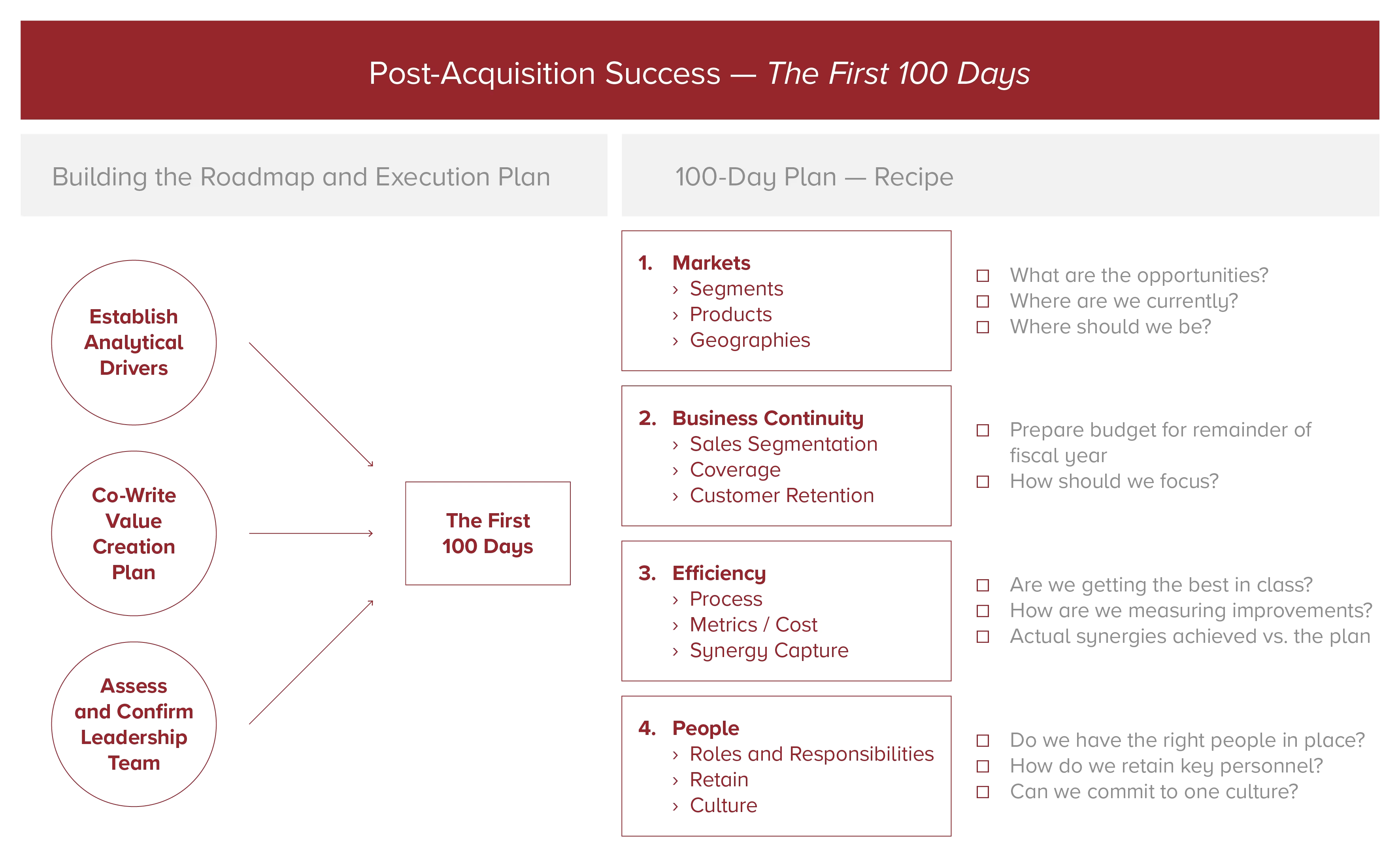
Markets
Once the deal closes, remember the end goal the transaction is expected to accomplish and do not lose sight of the investment thesis. Plans are easier to organize, implement, and manage when the desired goal is clearly defined.
Opportunities should have been identified in the diligence phase. Now it's time to execute on them. Define the playing field and understand how the target fits within that ecosystem. It may make sense to prioritize different channels and not pursue all simultaneously. For example, if the plan is to eventually expand geographically, it may be best to ensure the product/service offering is mastered in the current market before expanding elsewhere.
Business Continuity
Before and immediately after the transaction, spend time with existing customers and deliver a message of continuity. Delaying that message could lead the customer base—and potential new customers—to believe there are disruptions related to integration. Along those lines, operating with duplicative coverage territories to ensure continuity could make sense for a short time post-close, until the integration plan is completely buttoned up. Take a similar approach with vendors: Reinforce your intention to remain a good customer and do the diligence required to identify and mitigate any supply chain risks.
Shortly after close, prepare a budget for the remainder of the fiscal year and/or the following year. This helps keep the business moving forward and provides the team with the appropriate expectation of performance.
Efficiency
Process optimization throughout the organization will play a key role in the success of an integration plan. From streamlining cost rationalization initiatives to adopting new production capabilities to entering new distribution channels, the acquirer should strive to achieve the most efficient implementation of these strategies. KPIs should be established by the integration team, with individual ownership to ensure accountability, and benchmarked against competitive (and internal) data.
As integration initiatives are executed, progress against synergy capture should be tracked. Doing so allows workstreams to monitor progress against stated goals, identify and resolve issues in a timely manner, and ensure that value is being captured.
People
During diligence, an acquirer may only have access to a target's executive team. However, acquirers still need to have a plan before day one to retain personnel from senior level management to sales teams, division management, and key operating individuals throughout the organization.
Use the first 100 days to evaluate staff to assess if they are right for their roles. Having the right personnel in functions like sales and operations can ensure a smoother transition. Cultural fit is another potential challenge: It`s unlikely your two organizations will naturally have the same exact values and belief systems. Commit to the culture you want to see emerge and put it in place early.
It is also important to get to know the leaders and employees of the company to understand their economic motivations post-acquisition. Work with them to structure incentives that will help you achieve integration, revenue goals, and synergies. Everyone at all levels in the organization should have an understanding of the rationale and benefits of the acquisition, as well as the new organizational structure and benefits plans. This helps employee retention, and also ensures the messaging going into the market is consistent and does not jeopardize the success of the transaction.
Communication plans should be prepared pre-close and be ready to execute on day one. A best practice is to have management and HR on site on the day of close to share information and provide immediate feedback for those employees with questions or concerns.
Through robust diligence and integration planning up front, followed by swift and well-executed communication and implementation, acquirers can make great strides toward maximizing the value they anticipated and achieving their acquisition goals.
Lessons Learned
Maintain adherence to "acquisition – integration – feedback" process
Stress and facilitate exhaustive due diligence to uncover potential issues
Review compensation program discrepancies with company's management and discuss risks of altering/maintaining such programs
Ascertain capacity of acquired business entity prior to any rationalization
Discuss incentives to secure long-term commitment of key employees
Conclusion
Across this three-part series, we've shared important M&A fundamentals, highlighted a formal M&A process, and provided a number of concrete checklists in hopes of helping less-experienced acquirers gain confidence in pursuing an inorganic growth strategy. In the end, dedicating proper resources, whether internal or external, and following a robust procedure to proactively evaluate targets and manage an efficient transaction, take companies a long way toward successful inorganic growth.
Key Success Factors of Growth via M&A
Conduct exhaustive research: Assessing a large number of opportunities gives management an overall sense of what kinds of strategic acquisition opportunities exist and at what prices, making the company better able to assess the value of each prospect relative to the others.
Go direct: With focused acquisition criteria, the company will be more successful directly approaching targets with a consistent message than with an indirect approach—communicating acquisition criteria to the business brokerage community, which generally manages broad sale processes.
Buy wholesale, not retail: Do not wait for an investment banker to call about an opportunity they are engaged to execute. Proactively approach sellers before they decide to hire a representative.
Do not focus on price too early: It is more advantageous to sell the non-financial benefits first and address the price once there is momentum to the dialogue. However, it is important to avoid those sellers with unrealistic price expectations.
Cultivate alternatives: Always carry on dialogue with multiple potential targets. Knowing the alternatives makes it easier to judge the relative value of a deal at hand, and can shift the balance of power between the acquirer and the target.
Manage the deal cycle: The best acquisition campaigns ensure that the deal pipeline is always full to maintain momentum, as deals inevitably go away during the evaluation stage.
Evaluate and refine strategy and criteria: While maintaining discipline, the process should remain flexible as acquisition goals and objectives are further refined.
This concludes our series on growth via M&A. See our insights on the acquisition process, as well as five fundamentals of successful growth via M&A.