



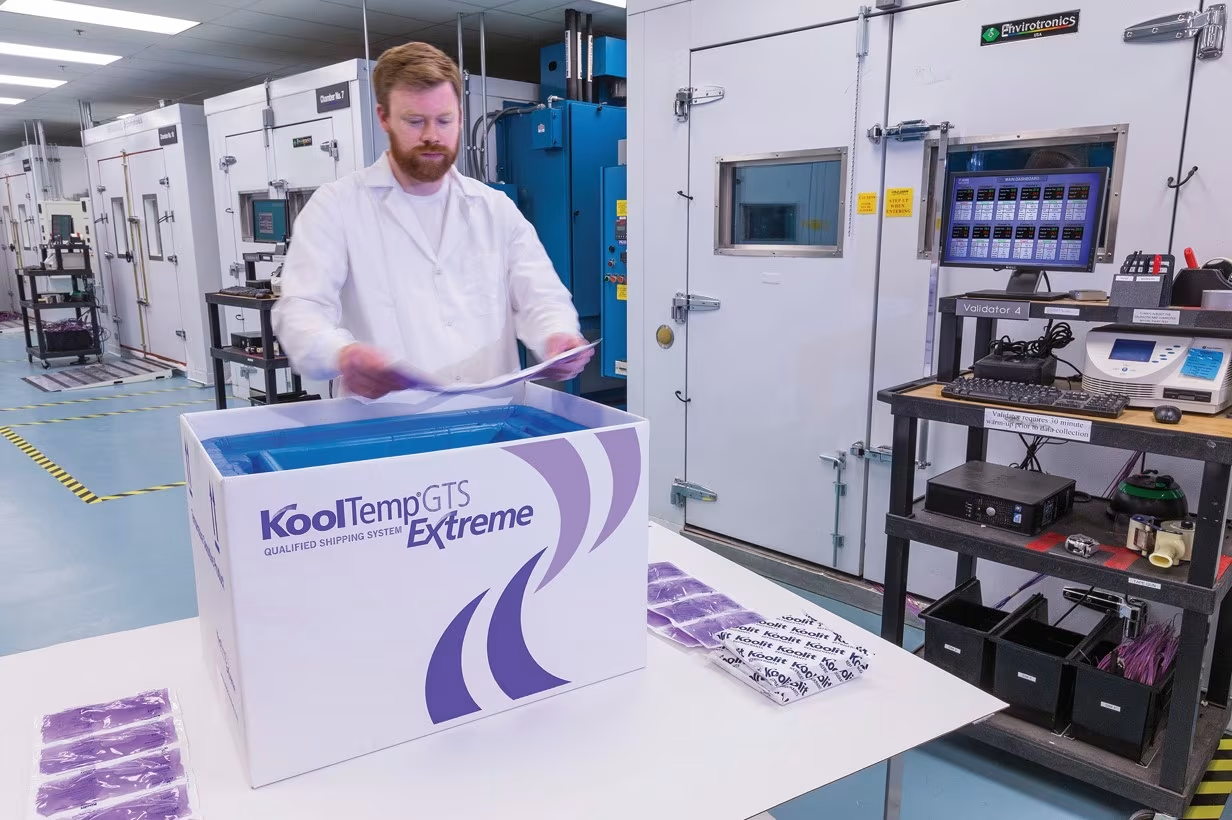
Article - March 6, 2024
Learn more about the Harris Williams professionals featured in this article.
While the pandemic put a spotlight on its complexities, the life sciences cold chain was already benefiting from long-term trends driving growth, including increasingly complex pharmaceuticals, and the globalization of clinical trials and post-trial distribution. The highly critical element of packaging is one of its most important facets and stands to benefit from this growth.
Indeed, without advanced cold chain packaging, many of today’s most critical life sciences products would fail to reach patients in optimal condition, jeopardizing the health and well-being of millions of people around the world. On top of consistent, flawless performance and product protection, cold chain packaging must also support sustainability goals while keeping costs under control. It’s a daunting challenge, requiring continual innovation.
Here, senior professionals from Harris Williams discuss this attractive sector with Ranjeet Banerjee, CEO of Cold Chain Technologies (CCT), a leading global provider of reusable, sustainable thermal packaging and digital solutions for the shipment of temperature-sensitive material, principally serving the life sciences industry.
A Conversation With Ranjeet Banerjee, CEO of Cold Chain Technologies
Morrison: Let’s start with an overview of your career and what drew you to Cold Chain Technologies a few years back.
Banerjee: I'm a chemical engineer by background, graduating from IIT Kanpur, India. I started with Unilever in India as a management trainee. In 1995 I joined Becton Dickinson, and I was there for 25 years in various leadership roles with increasing levels of responsibilities.
I joined CCT in 2020, right when the COVID-19 epidemic was starting to escalate. There were several factors that drew me to CCT. One was the significant unmet need for thermal assurance packaging for life sciences products. Around $35 billion of pharmaceutical products are wasted every year due to temperature excursions during transit.1 Also, when a vaccine or a drug product loses its efficacy due to a temperature excursion, it could be hard to tell without proper monitoring, which obviously impacts patient safety. COVID-19 put a spotlight on this issue. There’s a famous quote from that period: “You can have a vaccine, but that doesn't mean you have vaccinations.” That sums up the importance of what CCT does perfectly: being a key partner in the life sciences value chain from lab to patient.
Hepper: When you joined CCT, it was a fascinating time for this sector and for the business specifically. Can you give us some color on what's happened in the past three and a half years, and the initiatives you have put into place?
Banerjee: When I joined the company, CCT already had many extremely talented people with deep domain expertise. I also saw an opportunity to further strengthen some key functional areas. For example, we brought in a new finance leadership team. We also hired a head of strategy, M&A, and marketing, and we brought very capable leadership in the quality assurance function. As we operate in the life sciences industry, a focus on quality is essential in everything we do. Our team today is very solid, with deep domain expertise, industry knowledge, and process mastery.
Strategy is all about making choices, and we chose three key areas that we felt would drive growth and differentiation while creating significant value for our customers and for the business. One of those areas has been our passive reusable platform, EcoFlex. With reusables, there are many additional considerations, including tracking and tracing and achieving the required performance levels. We use digital technology to measure temperature and drive better decisions through automated insights and intelligence—because, again, there’s a patient at the end of the chain. Today, we have the largest fully qualified and digitally connected fleet servicing the life sciences industry.
The second area of focus has been expanding our global footprint through a series of strategic acquisitions, and we have made great progress on scaling the business globally.
Our third area of focus is sustainability, which is a very important topic for us and our customers. A major step was acquiring Packaging Technology Group, which added sustainable, curbside-recyclable thermal packaging to our portfolio. We’ve also developed lifecycle analysis capabilities that allow us to help customers quantify the sustainability benefits we enable them to achieve. This is a peer-reviewed, technology- and expertise-driven service that our customers really value.
Morrison: How do you think about staying agnostic toward insulation materials—choosing from the best third-party innovations—versus developing your own new materials in-house?
Banerjee: Overall, we’d rather stay agnostic toward insulation materials, working closely with established suppliers to design innovative solutions tailored to the needs of our customers. That helps us stay on the leading edge of the industry versus being tied to a particular material because of the time and energy we’ve invested in it.
Many of the established materials are made by large players and have multiple applications. We partner with those suppliers to understand their innovation and how it can fit into our solutions. For more nascent areas, like sustainability, suppliers are typically smaller, and we could consider acquiring them and internalizing their innovations or partnering with them to develop our capabilities.
Morrison: How do you think about M&A going forward?
Banerjee: M&A is always on our agenda. We have a well-defined process for business development, and we're always evaluating potential acquisitions. Some are companies that would add to our scale and geographic footprint, and others are strategic adjacencies that give us even more of an advantage in sustainability or technology.
We’re going to continue to pursue growth opportunities that help us generate more value for our customers, whether through global reach, a more diverse and advanced portfolio of materials, increasingly powerful digital technology, or a greater impact on their sustainability goals. M&A is one of the ways to make progress on our goal of being the leading end-to-end, full-service outsourced provider of advanced cold chain solutions.
Hepper: Could you give us your perspective on where the industry and CCT are going to be 5 to 10 years from now?
Banerjee: There’s a lot to be excited about, and plenty of opportunities for CCT. For one thing, every year more of the top-selling pharmaceuticals require cold chain packaging and related services. The most cutting-edge therapeutic modalities, like cell and gene therapy and other large-molecule biologics, require more condition and temperature monitoring. As such, pharmaceutical and diagnostics companies are increasingly looking for sophisticated partners like CCT. They are very focused on what they do, and they see the value of tapping into our expertise for their cold chain needs.
Sustainability is also going to continue to gain importance. Packaging has a disproportionate impact on sustainability, and we've set a goal of reducing landfill waste by 80 million pounds by the end of 2024. Since we started tracking this two years ago, we've already increased that goal three times. Reusables and sustainable single-use solutions will continue to grow as the life sciences industry seeks to reduce its environmental impact.
The use of digital technology is another key theme and will continue to become a more integral part of our products and services. One example is the tracking, tracing, and monitoring technology embedded in our reusable products. We’ve partnered with IoT specialists to add technology to our products that combines geolocation with ambient temperature data while monitoring the package’s temperature in real time. Tracking our reusable shipments as they move around the world creates a tremendous amount of data, and we’re studying how AI, augmented intelligence, and machine learning could help derive more insights for us and for our customers. For CCT, the most important thing is defining the value to our customers of those insights first and then backing into the right technology.
Ultimately, we’re not selling thermal packaging, we’re delivering assurance that life sciences products reach patients in optimal condition through a combination of high-performing products and services. We successfully partner with our customers today using that approach.
Perhaps most importantly, we’re focused on continuing to execute well as a cohesive team as we grow. We must continue to operate as a trusted knowledge partner for our customers, helping them reduce waste, cost, and patient risk. That requires close collaboration from planning to design, shipping and tracking, and optimizing. It means leaning into our innovative and diverse portfolio of offerings, including advanced insulation and phase change technologies, recyclable alternatives, and more. And we’re supplementing those capabilities with an effective interface of digital tracking and visibility that helps customers optimize their supply chains.
Overall, the future is bright, and we expect strong and growing demand for our innovative solutions for years to come.
To learn more, please contact our senior professionals.
IQVIA Institute for Human Data Science