



Article - October 28, 2026
Featured Professionals: Jason Bass, Jeff Kidd, Frank Mountcastle, Jon Meredith, Nick Petrick
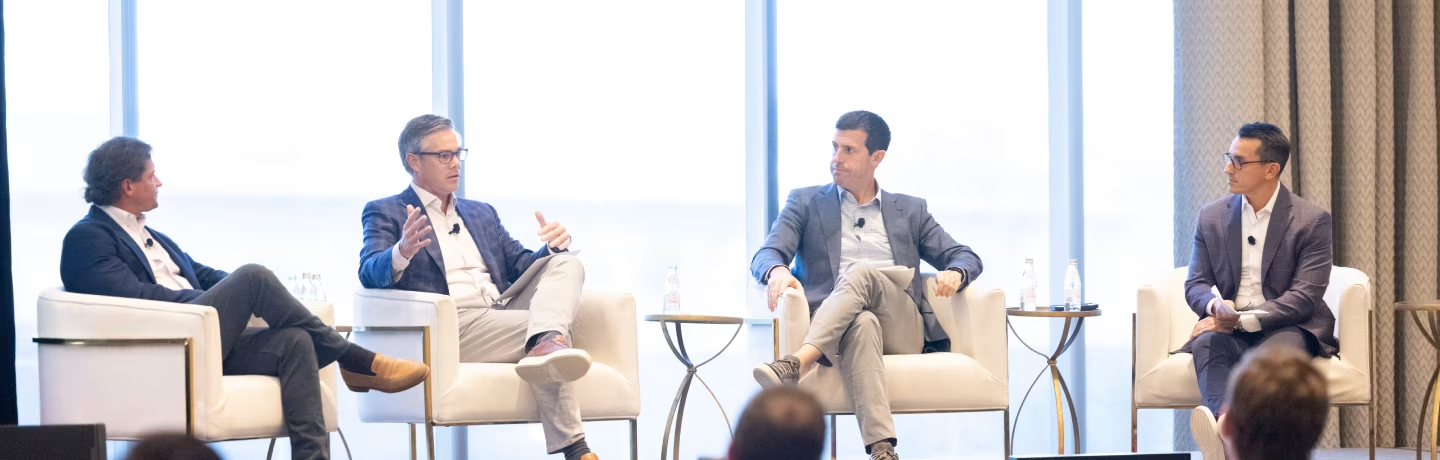
Our Transportation & Logistics Group recently hosted their 7th annual Harris Williams 3PL Conference in Nashville, welcoming logistics professionals and investors to share perspectives, ideas, and opportunities on the horizon.
This year’s discussions focused on the dynamic macro environment, the evolution of healthcare logistics, the freight market’s upcycle, growth in data center logistics, and how these trends are impacting M&A.
Across the sessions, a common theme emerged: Improving market conditions are creating opportunities, but the providers best positioned to capture them are those that can demonstrate specialized expertise, reliable execution, and durable multi-faceted growth.
Below, we share key insights and investment considerations from this year’s event.
Where Do We Go from Here? A Geopolitical Update
Jacob Shapiro, Independent Geopolitical Analyst
The day began with geopolitical analyst Jacob Shapiro’s perspective on the political, demographic, and technological changes reshaping global trade. His central message was that logistics providers should remain prepared for a dynamic market rather than wait for a return to a more predictable operating environment.
Shapiro described a shift from a unipolar to multipolar global power structure, with supply chains becoming more regional as companies reconsider where they manufacture, source, and distribute goods. In his view, this doesn’t mean trade opportunities are disappearing. Instead, greater integration within regions is creating new routes, relationships, and operating requirements.
For logistics professionals, that complexity can increase the value of expertise, flexibility, and problem-solving. Providers that can help customers respond to changing trade policies, transportation constraints, and sourcing decisions have an opportunity to compete on more than price and transit time.
Demographics are another important consideration. Shapiro highlighted aging populations and slower population growth as forces that could constrain labor availability and change long-term demand. He pointed to automation tools as increasingly important for supporting productivity as those pressures develop.
Shapiro also encouraged attendees to think about AI’s impact beyond the companies developing the technology. Drawing a comparison with containerization, he suggested that using AI to automate documentation and administrative work could make smaller, more specialized shipments easier and more economical to manage. At the same time, he cautioned that AI’s long-term potential does not eliminate the risk of a correction in investment levels or the infrastructure constraints surrounding its deployment.
Despite those risks, Shapiro’s outlook was constructive for businesses equipped to adapt, believing that every problem is an opportunity for forward-thinking logistics providers.
Healthcare Logistics: Precision, Compliance, and Growth
Nick Petrick, Director, Harris Williams (Moderator); Mike Clark, CEO, USPack Logistics Corp.; Robert Coyle, CEO, BioTouch; Dan Di Piazza, Managing Director, JLL Partners; James Eshleman, Vice President, Corporate Development and M&A, UPS
Our healthcare logistics session examined how more complex treatments and changing care settings are increasing demand for specialized logistics services. Panelists described logistics as an increasingly important part of delivering care, rather than simply the transportation function behind it.
Personalized therapies, biologics, and radiopharmaceuticals can require exacting temperature controls, delivery windows, and chain-of-custody procedures. Meanwhile, the movement of care into homes and outpatient settings is creating more varied delivery requirements and making the patient’s experience at the door increasingly important.
Those demands create opportunities for providers that understand the clinical context of a shipment and can respond when something goes wrong. The discussion distinguished visibility into a shipment’s location from the ability to control its movement and recover quickly from a disruption.
Panelists also emphasized that healthcare logistics is not one uniform market. “Transporting specimens, assembling diagnostic kits, and delivering advanced therapies require different capabilities and operating models,” says Nick Petrick, a director. “For investors and operators, defining where a business can excel is an important starting point for growth and acquisition strategies.”
Regulatory compliance and quality systems were recurring themes, both as operating necessities and as sources of differentiation. Training, documented processes, and consistent execution can strengthen customer relationships while creating meaningful barriers for less specialized competitors.
The panel saw a substantial M&A opportunity in combining high-quality local providers with broader networks, customer access, and integrated systems. “However, successful combinations need to improve capabilities, geographic coverage, or delivery density versus simply adding another business with a healthcare label,” adds Petrick.
The Beginning of the Upcycle
Frank Mountcastle, Managing Director, Harris Williams (Moderator); Thom Albrecht, Chief Revenue Officer, Reliance Partners; Dave Ross, EVP, Chief Strategy Officer, Roadrunner
Our freight cycle discussion explored an important distinction: Market conditions can improve because capacity is leaving the system, even before demand strengthens broadly. Our panelists both saw signs of improvement, while offering different perspectives on the potential strength and duration of the recovery.
For instance, Ross pointed to improving industrial and transportation indicators but remained cautious about the outlook for freight volumes. He noted that economic growth does not always translate directly into trucking demand, particularly when spending shifts toward high-value products that require relatively little freight capacity.
Albrecht described the environment as a difficult yet healthy market, reflecting a better supply-demand balance alongside continued pressure from fuel, wages, and financing costs. He suggested that tighter safety and operating requirements could help keep capacity growth in check and support a longer recovery.
The discussion also identified risks to that outlook, including renewed capacity growth, a slowdown in AI-related investment, and a change in the pace of regulatory enforcement. The possibility of a stronger cycle was presented as an opportunity rather than a certainty.
For investors, the panel placed considerable weight on company-specific strengths rather than selecting a particular transportation mode. Risk management was another important consideration, with the discussion highlighting the ability to explain and substantiate carrier-selection decisions. “Culture, sound operating decisions, reliable service, and the ability to adapt to changing supply chains are recurring characteristics of attractive businesses,” says Frank Mountcastle, a managing director.
Data Center Logistics: Powering the Digital Economy
Jon Meredith, Managing Director, Harris Williams (Moderator); Ken Beam, Founder and CEO, Pegasus Logistics Group; Jenson Dunn, Managing Director, Harris Williams; Bill Fallon, Chief Sales Officer, Technology, AIT Worldwide Logistics
This session explored the physical supply chains behind the expansion of AI and digital infrastructure. While investment announcements attract much of the attention, panelists focused on the expertise required to move equipment securely and deliver it in the right sequence and at the right time.
The discussion described how increasing computing density is changing data center design and creating requirements for larger power, cooling, and supporting infrastructure. The group highlighted a shift toward modular equipment assembled offsite, which can reduce construction variability but requires carefully coordinated transportation and delivery.
For logistics providers, the resulting opportunity is highly demanding. “Equipment is valuable, schedules are tight, and missed deliveries can delay a customer’s ability to generate revenue,” says Jon Meredith, a managing director. “It’s all about reliability and scale.”
Panelists emphasized that a credible offering requires an established carrier network, security capabilities, specialized handling, and the flexibility to respond quickly when plans change. Those requirements can make entry difficult for providers without a relevant track record, even when the growth opportunity is compelling.
Power availability is also influencing where customers build, pushing logistics providers to prepare for new markets and freight patterns. Rather than waiting for a shipment request, leading providers described working with customers during planning to establish capacity and capabilities ahead of deployment.
The session offered an optimistic perspective on the durability of AI infrastructure investment, while identifying demand beyond initial construction. Equipment replacement, upgrades, reverse logistics, and continued cloud adoption were discussed as additional sources of activity.
“For investors, it’s important to understand the capabilities and customer relationships behind a provider’s exposure to this market, rather than relying on the growth of data center spending alone,” adds Meredith.
Deal Dynamics: The Evolving M&A Landscape in 3PL
Pete Suffredini, Partner, TJC, L.P. (Moderator); Jason Bass, Group Head and Managing Director, Harris Williams; Jeff Kidd, Managing Director, Harris Williams; Jon Meredith, Managing Director, Harris Williams
Our final session of the day examined how improving operating conditions are translating into buyer interest and transaction activity. Panelists described a more constructive outlook for 2027, supported by pent-up demand for exits, available financing, and renewed activity in traditional logistics models alongside continued interest in specialized providers.
However, the market remains selective, with experienced transportation and logistics investors among the most active buyers. “Specialization doesn’t only mean serving one narrow end market,” says Jason Bass, a managing director. “It's more important to demonstrate to the market that you have a specialized skillset, which can fuel superior customer retention, margins, and volume growth.”
As conditions improve, sellers need to distinguish company-specific progress from gains driven by the broader rate environment. “New customer wins, increased shipment volumes, expanded customer relationships, and multiple avenues for growth can help substantiate that distinction,” notes Jeff Kidd, a managing director.
Data quality is increasingly central to making the case: Buyers want to separate pricing from volume, compare performance over time, and understand results by customer, end market, location, and acquisition. The panel linked that preparation to greater underwriting confidence, a more efficient process, and potentially stronger valuation outcomes.
The discussion also addressed AI, with panelists describing operational efficiency opportunities rather than a broad withdrawal of investor interest from the sector. They noted that the complexity of many logistics services remains important when assessing how much work can realistically be automated.
Looking ahead, panelists saw the potential for more transactions but also a wider gap in outcomes between differentiated businesses and those more dependent on market recovery. Deep customer relationships, durable earnings, and strong supporting data were highlighted as characteristics likely to sustain buyer interest.
The closing message was to assess success more broadly than the highest valuation multiple. “A healthier market is one in which businesses trade at fair values, and both buyers and sellers can achieve their objectives,” says Meredith.
Specialized Expertise and Long-Term Growth
This year’s conference highlighted several avenues to growth, from helping customers navigate changing trade patterns to supporting more complex healthcare and technology supply chains. Across those opportunities, the discussions returned to a consistent set of strengths, including a clear market focus, dependable service, thoughtful investment, and evidence that a business can grow through changing conditions.
To learn more about the event and discuss the latest 3PL M&A trends, please contact our Transportation & Logistics Group professionals.