Article - October 28, 2025
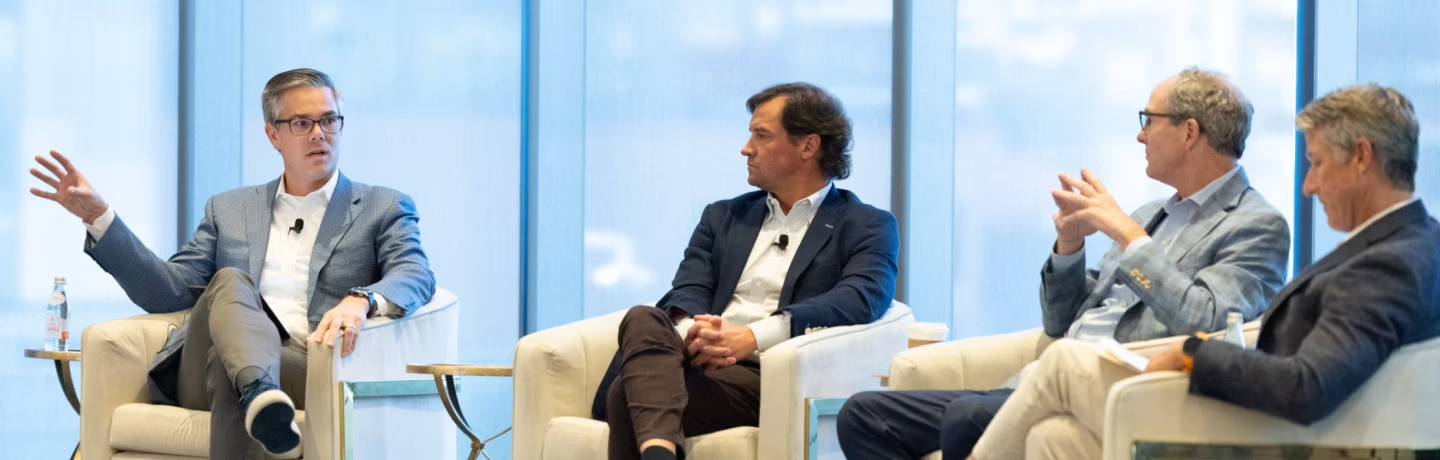
Our Transportation & Logistics Group recently hosted their 6th annual Harris Williams 3PL Conference in Nashville, bringing together industry leaders and investors to connect and share ideas on a wide range of topics impacting the 3PL landscape.
Specifically, our panelists and attendees explored the outlook for the global economy, the future of AI in logistics, tactics to manage trade turbulence and tariffs, succession planning and talent strategies, and the evolving M&A landscape in this dynamic sector.
Below, we share key insights into the changes happening in logistics and the opportunities being created drawn from this year’s event.
Outlook for the Global Economy Amidst Bending and Breaking Supply Chains
Jason Schenker, President and Chief Economist of Prestige Economics; Chairman, The Future Institute
Our day kicked off with President and Chief Economist of Prestige Economics Jason Schenker’s Outlook for the Global Economy Amidst Bending and Breaking Supply Chains.
The session focused on the reshaping of economic and market dynamics worldwide, which is causing strain on global supply chains. Schenker, a top-ranked economist and futurist, examined the challenges and opportunities emerging from supply chain disruptions, trade conflicts, and changing geopolitical risks.
During his overview of today’s economic and political conditions, Schenker shared that the levers of economic power in the U.S. remain strong, including GDP, capital stock, wealth, the labor market, and access to debt markets. However, he also noted that the factors impacting the country’s self-sufficiency—from materiel production to dual-use technology to raw materials—are somewhat less robust.
Against this backdrop, economic forecasts reflect growth despite a dynamic global trade environment. Supporting this positive outlook are recent U.S. real GDP increases and healthy consumer metrics, including low debt delinquencies, high credit scores, and low unemployment. And for the 3PL sector specifically, steadily growing shipments and the expansion of e-commerce are helping fuel momentum.
Although the foundations for growth are in place for 3PLs, the labor market continues to be a key challenge. In fact, according to Schenker, the transportation, warehousing, and utilities space had over 350,000 open jobs in August 2025.
“Open jobs and rising wages can compress margins and create some hurdles for 3PLs,” says Jason Bass, a managing director at Harris Williams. “Leading providers are addressing this by building cultures people want to be a part of while putting resources toward the hiring and retention of top talent.”
Schenker also discussed the proliferation of AI and its impact on 3PLs in terms of productivity, data analysis, cost savings, and operational efficiency. “Technology is vital for differentiation and growth throughout the 3PL ecosystem,” explains Bass. “More advanced automation and AI capabilities can support productivity and efficiency and drive value both internally and for shipper partners.”
Schenker’s recommendations for 3PLs to successfully navigate the current environment include prioritizing reliability over cost, preparing for additional domestic industrial demand and related supply chain pressures, de-risking operations amid geopolitical conflicts, and strengthening supply chains to better manage market turbulence.
“Today’s 3PL landscape is very dynamic, creating opportunities for companies that can keep up,” says Bass. “Heading into 2026, the best 3PLs will grow and capture market share by adopting innovative technology and tools, identifying cost-saving initiatives, uncovering new regional opportunities to tap into, and helping shippers diversify their supply chains.”
3PLs: The Future of AI in Third-Party Logistics
Adam Kirsch, Director M&A, West Monroe (Moderator)
Miles English, Chief Digital Officer, Transportation Insight
Andrew Kunkel, Partner, Bain & Company
Cameron Ramsdell, CEO, Armstrong Transport Group
Berkley Stafford, CEO, TransImpact
Doug Waggoner, CEO, Echo Global Logistics
Another important topic at the conference was The Future of AI in Third-Party Logistics. As we discussed during the session, AI is no longer just a buzzword—it's actively transforming the 3PL industry. Panelists explored tactical, real-world applications, including automating routine tasks, augmenting team capacity and speed, and freeing professionals up for higher-level tasks. Participants also shared lessons learned from AI adoption and points in the value chain where AI is underused or misunderstood.
Panelists agreed that while AI adoption has its challenges, the technology can unlock significant opportunities for forward-thinking logistics providers to separate themselves from the competition. “A range of logistics providers see AI as a clear path to differentiation,” says Nick Petrick, a director at Harris Williams. “Although successful implementation is difficult, especially at scale, AI can help solve tough problems.”
A primary theme of the session was translating AI-driven efficiencies into quantifiable returns on investment, with leading 3PLs uncovering ways to redesign core workflows, centralize functions, and change how day-to-day work gets done. “While AI can automate many daily tasks, from processing emails to tracking shipments, this doesn't automatically equate to meaningful productivity improvements,” says Petrick. “The next phase is centralizing key work functions to establish efficiencies that make a bigger difference. This transition also creates more potential for talented professionals to focus their time and energy on higher-value tasks.”
A significant hurdle identified by the panel is that both employees and clients often lack AI experience. One participant noted that many shippers simply “don't have the questions to ask” of a powerful AI platform. This opens up 3PLs to elevate their role from a service provider to a strategic decision-making partner.
For instance, by investing in robust internal training and building a culture of AI literacy, best-in-class 3PLs can become trusted partners who guide their clients through the complexities of AI. Such providers that can help shippers ask the right questions, interpret data, and integrate AI-driven insights into their operations will continue to generate immense value for their customers.
“Looking forward, AI capabilities will rapidly become table stakes,” says Petrick. “The long-term winners will be those who intelligently implement and scale AI while ensuring high levels of data quality to solve the industry's toughest challenges.”
Tariff Tactics: Steering Through Trade Turbulence
Evan Armstrong, CEO, Armstrong & Associates (Moderator)
Bohn Crain, Founder & CEO, Radiant Logistics
Dante Fornari, CEO, Imperative Logistics Group
Greta Schmitt, Executive VP, Mid-Americas Overseas
Kendra Tanner, President & CEO, Allstates WorldCargo
As we discussed in our session, Tariff Tactics: Steering Through Trade Turbulence, tariffs and shifting trade policies continue to create volatility in global logistics. Our panel participants explored specific ways companies can navigate short-term disruptions without losing sight of their long-term goals, while uncovering the strategic opportunities that arise in turbulent times.
Although the panelists acknowledged intensifying pressure on shippers, they agreed that for agile and sophisticated 3PLs, this disruption is a significant opportunity to prove their strategic worth. “The key is moving beyond transactional freight services and becoming vital partners in handling complexity,” says Jon Meredith, a director at Harris Williams.
And due to escalating tariffs, the participants also noted a major shift in the importance of trade compliance. “Strong trade compliance programs have become mission-critical,” adds Meredith. “It’s a strategic and cost-saving opportunity, and shippers are relying on 3PL partners for help.”
These factors create a powerful opportunity for 3PLs to bring consulting, customs brokerage, and advisory services to their customers, thus establishing deeper relationships. This expertise across a wider range of services is key as more clients consolidate their logistics needs with the companies that can solve their most complicated and expensive problems.
In addition, the panel said that today’s rapidly changing conditions are driving more sophisticated and nuanced strategies to help clients manage risk and cost. For instance, leading 3PLs are now guiding clients on cost-saving strategies like leveraging FTZs and bonded warehouses, supply chain reconfiguration around tariffs, and opportunities to establish nearshore manufacturing.
The overarching message from the participants was clear: In times of crisis, the best 3PLs thrive. “There are many customers seeking solutions or a path forward,” says Meredith. “3PLs that combine deep compliance expertise with tactical solutions and strategic guidance will be the best positioned to support their clients going forward.”
Passing the Torch: Succession Strategies
Meredith Moot, Senior Client Partner, Korn Ferry (Moderator)
Lance Malesh, CEO, Mode Transportation
Jim Mitchel, Partner, Harvest Partners
Nick Reasoner, Founder & CEO, TransLoop
Raul Villarreal, CEO, Source Logistics
As highlighted in Passing the Torch: Succession Strategies, leadership continuity is essential for long-term success. This session delved into effective succession planning, talent development, and executive transition strategies to prepare for the future. Among other topics, the discussion focused on how talent needs evolve with scale, ways to make culture a deliberate and top-down initiative, and approaches to integrating new talent without diluting the current culture.
For many founder-led 3PLs, succession is a challenge that can dictate the company's ultimate value and legacy. Our panel participants agreed that the most successful handoffs are often the result of deliberate planning, difficult conversations, and a shift to scalable, professional management. “Although succession planning can be difficult, it’s also a significant chance to fortify an organization for its next stage of growth,” says Jeff Kidd, a managing director at Harris Williams.
The journey for many leading 3PLs begins with a founder's vision and entrepreneurial culture. However, as a company grows and attracts outside investment, that culture must evolve. The panel highlighted the importance of transitioning to a team that can get the business to the next level.
To effectively navigate this change, 3PLs must attract, hire, and retain talented professionals that can take on new roles with higher complexity and different skills. “Finding differentiated talent is a major opportunity for 3PLs,” says Kidd. “By addressing skill and performance gaps, 3PL leaders can drive long-term company health and growth.”
This professionalization, often accelerated by a private equity partner, reinforces a high-performance culture and creates upward mobility for the next generation of talent. And when evaluating a potential investment, financial sponsors look for these types of leadership teams. As one private equity partner noted during the session, true partnership is built on a foundation of trust and transparency, enabling joint problem-solving when obstacles arise.
This dynamic creates an opportunity for founders to differentiate themselves by being candid about their company’s opportunities and their own succession plans. “Investors typically aren’t deterred by the need for change, but they want to back a founder who’s prepared to take it on,” says Kidd. “Honest conversations about a founder’s timeline and potential successors can signal to investors that the business is poised for a new chapter of growth.”
Throughout the panel discussion, participants offered vital ingredients for navigating the complexities of succession, including embracing difficult conversations, prioritizing transparency with partners, defining the founder's future role, and clearly communicating the vision. “Ultimately, passing the torch is not a sign of weakness but a mark of strategic maturity,” says Kidd. “For 3PL leaders who manage it well, succession becomes an exciting opportunity to build an enduring, high-value business.”
Deal Dynamics: The Evolving M&A Landscape in 3PL
JJ Schickel, Co-founder, EVE Partners (Moderator)
Jason Bass, Group Head, Harris Williams
Jeff Kidd, Managing Director, Harris Williams
Frank Mountcastle, Head of M&A, Harris Williams
As we discussed during Deal Dynamics: The Evolving M&A Landscape in 3PL, the 3PL M&A market continues to show many signs of a rebound, driven by a potent combination of pent-up supply, substantial private equity dry powder, and supportive debt markets.
The panel discussed the 3PL sector’s profound transformation and maturation over the past two decades, developing into a sophisticated sector attracting strong investor interest. Frank Mountcastle, a managing director at Harris Williams, noted the C-suite's focus on supply chain resilience and the deep, broad interest from private equity as key drivers of this evolution. “I can remember when we had to educate investors about the merits of 3PL business models,” says Mountcastle. “Today, those merits are well understood, with leading 3PLs being highly sought after by private equity groups.”
This institutionalization has spurred a more competitive M&A dynamic, with strategic buyers, sponsor-backed strategics, and an expanding universe of financial investors all seeking best-in-class platforms. Despite these positive long-term trends, the panelists agreed that the market has recently been defined by increased buyer scrutiny.
“While the environment remains a ‘prove it to me’ market, high-quality, data-backed, and specialized 3PLs are positioned to command premium outcomes as M&A momentum continues to build,” says Kidd.
Another area where top-tier 3PLs are finding an edge is specialization. In a volatile freight market, those focused on specific, resilient end markets or complex service offerings are out-performing. “We’re seeing elevated interest in specialty models serving a unique customer set, service offering, or end market,” says Mountcastle. “Such businesses, like those operating in healthcare, pharma services, food and beverage, and consumer packaged goods or those catering to data centers, are often more insulated from broader market cyclicality.”
Meanwhile, several forces are converging to unlock more deal flow, including an unprecedented amount of private equity dry powder, an aging backlog of PE-owned 3PLs, and constructive debt markets.
“While the 3PL market has endured a challenging period, its underlying fundamentals remain strong,” says Bass. “Great 3PLs can be sold in almost any market, and those with a defensible niche and a proven track record of performance will continue to be well positioned to win.”
Real-Time Innovation and Value Creation
As in previous years, our 6th annual Harris Williams 3PL Conference was attended by experienced professionals from across the 3PL landscape, reflecting the building momentum in this space.
“This year, distinguished leaders converged from all corners of the 3PL world—evidence of the excitement being felt throughout the sector,” says Bass. “It was a privilege to learn from our panelists, attendees, and partners, and to be part of the conversations driving innovation and value creation in today’s global supply chains.”
To learn more about the event and discuss the latest 3PL M&A trends, please contact our senior professionals.